


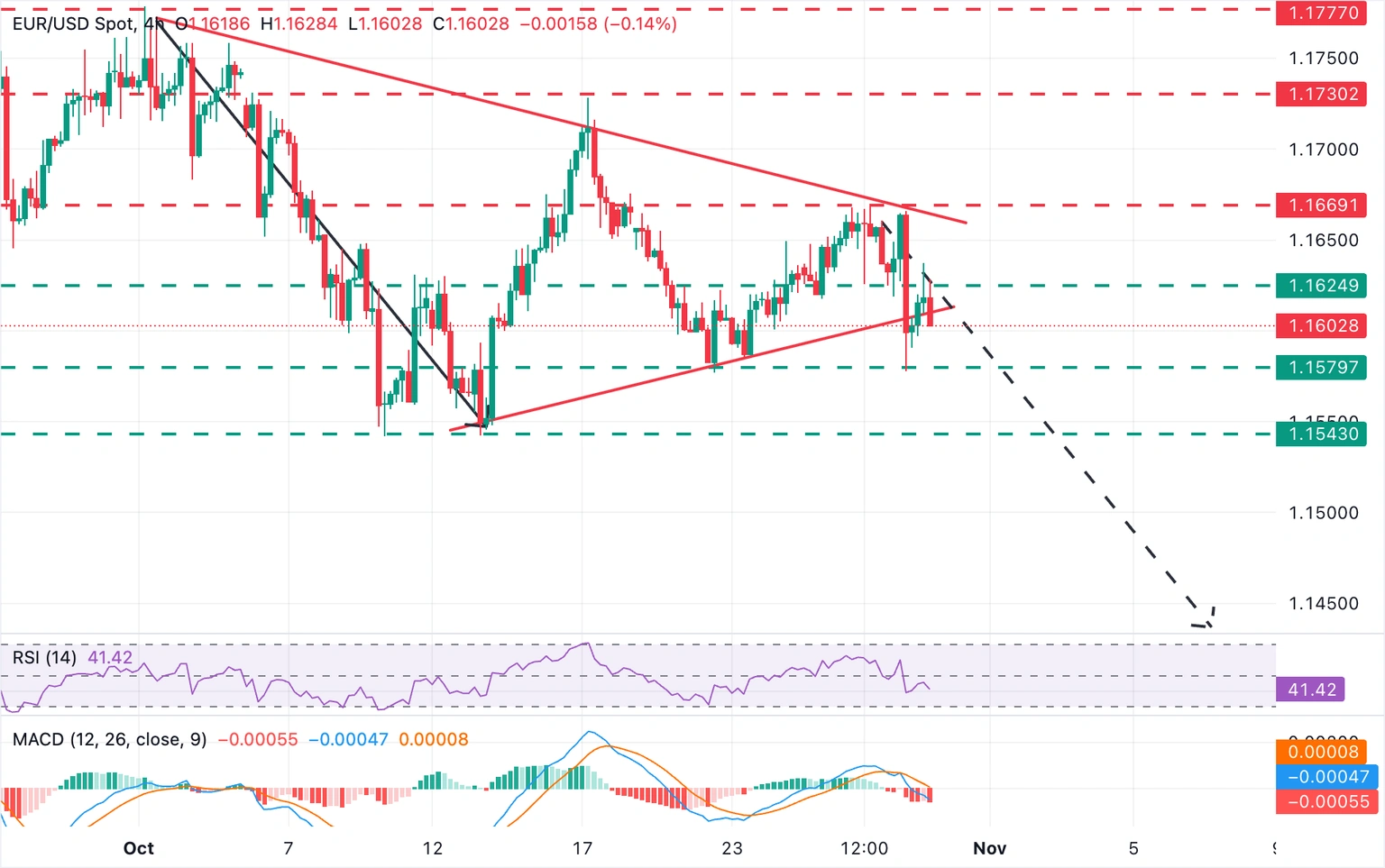
EUR/USD is giving away previous gains and returns to levels near the 1.1600 area at the time of writing, from session highs at 1.1635. Markets remain cautious ahead of the European Central Bank’s (ECB) monetary policy decision, which leaves the pair treading water despite the good news from the Sino-US trade deal and better-than-expected Eurozone Gross Domestic Product (GDP) figures.
Eurozone’s preliminary GDP data revealed that the economy accelerated to 0.2% in the third quarter, beating expectations of a 0.1% growth. Apart from that, the economic sentiment has improved beyond expectations, with confidence in the industrial and services sectors’ activity also improving.
Earlier on the day, US President Donald Trump affirmed on Thursday that he had an “amazing” meeting with Chinese President Xi Jinping. The US will reduce tariffs on Chinese imports while the Asian country will keep rare earths trade flowing, resume purchases of US soybeans, and stop the fentanyl trade.
The reaction of Chinese President Xi has been more laconic, but he acknowledged a consensus on “important economic and trade issues”. Investors have welcomed the news, but the market reaction has been moderate.
On Wednesday, the Federal Reserve cut interest rates by 25 basis points (bps) as widely expected, but Chairman Jerome Powell shocked markets, putting into question another cut in December. The US Dollar surged across the board following Powell’s press conference.
Euro Price Today
The table below shows the percentage change of Euro (EUR) against listed major currencies today. Euro was the strongest against the Japanese Yen.
| USD | EUR | GBP | JPY | CAD | AUD | NZD | CHF | |
|---|---|---|---|---|---|---|---|---|
| USD | -0.03% | 0.08% | 0.80% | 0.22% | 0.19% | 0.11% | 0.05% | |
| EUR | 0.03% | 0.10% | 0.88% | 0.25% | 0.21% | 0.14% | 0.08% | |
| GBP | -0.08% | -0.10% | 0.73% | 0.14% | 0.11% | 0.03% | -0.03% | |
| JPY | -0.80% | -0.88% | -0.73% | -0.62% | -0.63% | -0.73% | -0.80% | |
| CAD | -0.22% | -0.25% | -0.14% | 0.62% | -0.02% | -0.11% | -0.17% | |
| AUD | -0.19% | -0.21% | -0.11% | 0.63% | 0.02% | -0.07% | -0.14% | |
| NZD | -0.11% | -0.14% | -0.03% | 0.73% | 0.11% | 0.07% | -0.04% | |
| CHF | -0.05% | -0.08% | 0.03% | 0.80% | 0.17% | 0.14% | 0.04% |
The heat map shows percentage changes of major currencies against each other. The base currency is picked from the left column, while the quote currency is picked from the top row. For example, if you pick the Euro from the left column and move along the horizontal line to the US Dollar, the percentage change displayed in the box will represent EUR (base)/USD (quote).
Daily digest market movers: The Euro hesitates ahead of the ECB
- The positive comments after the China-US trade negotiations have lifted market sentiment somewhat, allowing the Euro to regain some of the ground, but upside attempts have remained limited, despite the supportive Eurozone data, with investors awaiting the outcome of the ECB’s monetary policy decision..
- On Wednesday, the Fed cut interest rates by 25 bps to the 3.75% – 4.0% range, yet with voters showing a wide divergence. There were two dissenters on the committee, one called for a 50 bps rate cut while the other wanted to hold rates steady.
- The shock, however, came when the Fed Chair Jerome Powell said that the path forward “is not a foregone conclusion – far from it”, as the combination of rising inflation and higher unemployment poses conflicting monetary policy needs. Investors pared back hopes of a December rate cut in favour of January, and the US Dollar rallied.
- In the Eurozone, the preliminary Q3 GDP has shown a 0.2% increase, from 0.1% in the previous quarter and beyond market expectations of a steady 0.1% growth. Year-on-year, the region’s economy grew at a 1.3% pace, below the previous quarter’s 1.5% but also beating expectations of a 1.2% growth.
- The European Commission’s Economic ªSentiment Indicator has improved to 96.8 in October from 95.6 in September, beyond the market consensus of a 95.7 reading. Likewise, Industrial confidence has risen to -8.2 from -10.1, beating the market forecasts of a -10.0 reading, and Services Sentiment improved to 4 from 3.7 against expectations of a decline to 3.3. Consumer Confidence has remained steady at -14.2.
- The Unemployment rate has remained at 6.3% in September, unchanged from the previous month, in line with the market consensus.
- Somewhat earlier, German preliminary Q3 GDP figures revealed that the economy stalled, following a 0.3% contraction in the previous quarter. The yearly GDP has bounced up to a 0.3% growth after a 0.2% contraction in Q2, in line with expectations.
- The highlight of the day will be the ECB’s monetary policy decision, due at 13:15 GMT. The bank will, highly likely, leave its Rate on the Deposit Facility unchanged at 2% but investors would be eager to know whether this is the terminal rate or if there is still room for further monetary easing.
Technical Analysis: EUR/USD is forming a triangle pattern
The EUR/USD keeps looking for direction, with price action moving within an ever-narrowing range, forming a symmetrical triangle. This is considered a continuation pattern, which points to a nearish outcome. Technical indicators support that view. The 4-hour Relative Strength Index (RSI) is below 44, and the Moving Average Convergence Divergence (MACD) has crossed below the signal line.
Wednesday’s impulsive bearish candle suggests an increasing bearish momentum, although the support area near 1.1580 (October 22, 23 lows) keeps limiting downside attempts and closing the path towards the key support area around 1.1545 (October 9 and 14 lows). The measured target of the triangle pattern is at the 1.1450 area.
To the upside, the pair is struggling to extend gains above a previous support at 1.1625 (October 28 low). Above here, the top of the triangle pattern comes around 1.1665, and the October 28 and 29 highs lie around 1.1670. Further up, the next target is the October 17 high, near 1.1730.
ECB FAQs
The European Central Bank (ECB) in Frankfurt, Germany, is the reserve bank for the Eurozone. The ECB sets interest rates and manages monetary policy for the region.
The ECB primary mandate is to maintain price stability, which means keeping inflation at around 2%. Its primary tool for achieving this is by raising or lowering interest rates. Relatively high interest rates will usually result in a stronger Euro and vice versa.
The ECB Governing Council makes monetary policy decisions at meetings held eight times a year. Decisions are made by heads of the Eurozone national banks and six permanent members, including the President of the ECB, Christine Lagarde.
In extreme situations, the European Central Bank can enact a policy tool called Quantitative Easing. QE is the process by which the ECB prints Euros and uses them to buy assets – usually government or corporate bonds – from banks and other financial institutions. QE usually results in a weaker Euro.
QE is a last resort when simply lowering interest rates is unlikely to achieve the objective of price stability. The ECB used it during the Great Financial Crisis in 2009-11, in 2015 when inflation remained stubbornly low, as well as during the covid pandemic.
Quantitative tightening (QT) is the reverse of QE. It is undertaken after QE when an economic recovery is underway and inflation starts rising. Whilst in QE the European Central Bank (ECB) purchases government and corporate bonds from financial institutions to provide them with liquidity, in QT the ECB stops buying more bonds, and stops reinvesting the principal maturing on the bonds it already holds. It is usually positive (or bullish) for the Euro.
