



Gold (XAU/USD) stages a rebound on Thursday as the US Dollar (USD) edges lower following fresh headlines surrounding a potential US-Iran peace deal and softer US inflation data. At the time of writing, XAU/USD is trading around $4,480 after hitting an intraday low of $4,366 earlier in the day, its lowest level in two months.
Axios reported on Thursday that the US and Iran have reached a preliminary 60-day agreement to extend the current truce, though the deal still awaits final approval from US President Donald Trump. This comes after US armed forces carried out a second “defensive” strike this week on Iranian military facilities. In response, Iran’s Islamic Revolutionary Guard Corps (IRGC) claimed it targeted a US airbase in the Gulf region and warned of “more decisive” action if US “aggression” continues, according to state media.
On the data front, the core PCE Price Index, the Federal Reserve’s (Fed) preferred inflation gauge, rose 0.2% MoM in April, below market expectations and down from the 0.3% increase recorded in March. On a yearly basis, the Core PCE climbed to 3.3%, up from 3.2% in March and in line with analyst forecasts.
The US Dollar Index (DXY), which tracks the Greenback’s value against a basket of six major currencies, is trading around 99.00, easing after hitting a seven-week high of 99.54 earlier in the day.
Although negotiations continue to face hurdles over Iran’s nuclear program and control of the Strait of Hormuz. Tehran is also pushing for sanctions relief and the release of frozen Iranian assets. US President Donald Trump told PBS News on Wednesday that Iran would not receive sanctions relief in exchange for giving up highly enriched uranium.
Until a final agreement is reached, downside in the US Dollar appears limited. Traders continue to favor the US Dollar (USD) over Gold as a safe-haven asset. The metal has remained on the back foot since the war began in late February, as markets increasingly focus on inflation risks stemming from rising Oil prices.
Higher energy costs are adding to inflationary pressures, heightening expectations that major central banks, including the Fed, may need to keep interest rates higher for longer or even raise them. As a result, US Treasury yields remain elevated, reducing the appeal of non-yielding assets such as Gold.
Fed Vice Chair Philip Jefferson said on Thursday that rising energy prices are “a downside risk to growth” and “a potential inflation driver.” He added that the Fed remains “firmly committed to restoring inflation to 2%” and noted that recent US economic activity “remains robust.”
Technical Analysis: Bears retain control below key moving averages
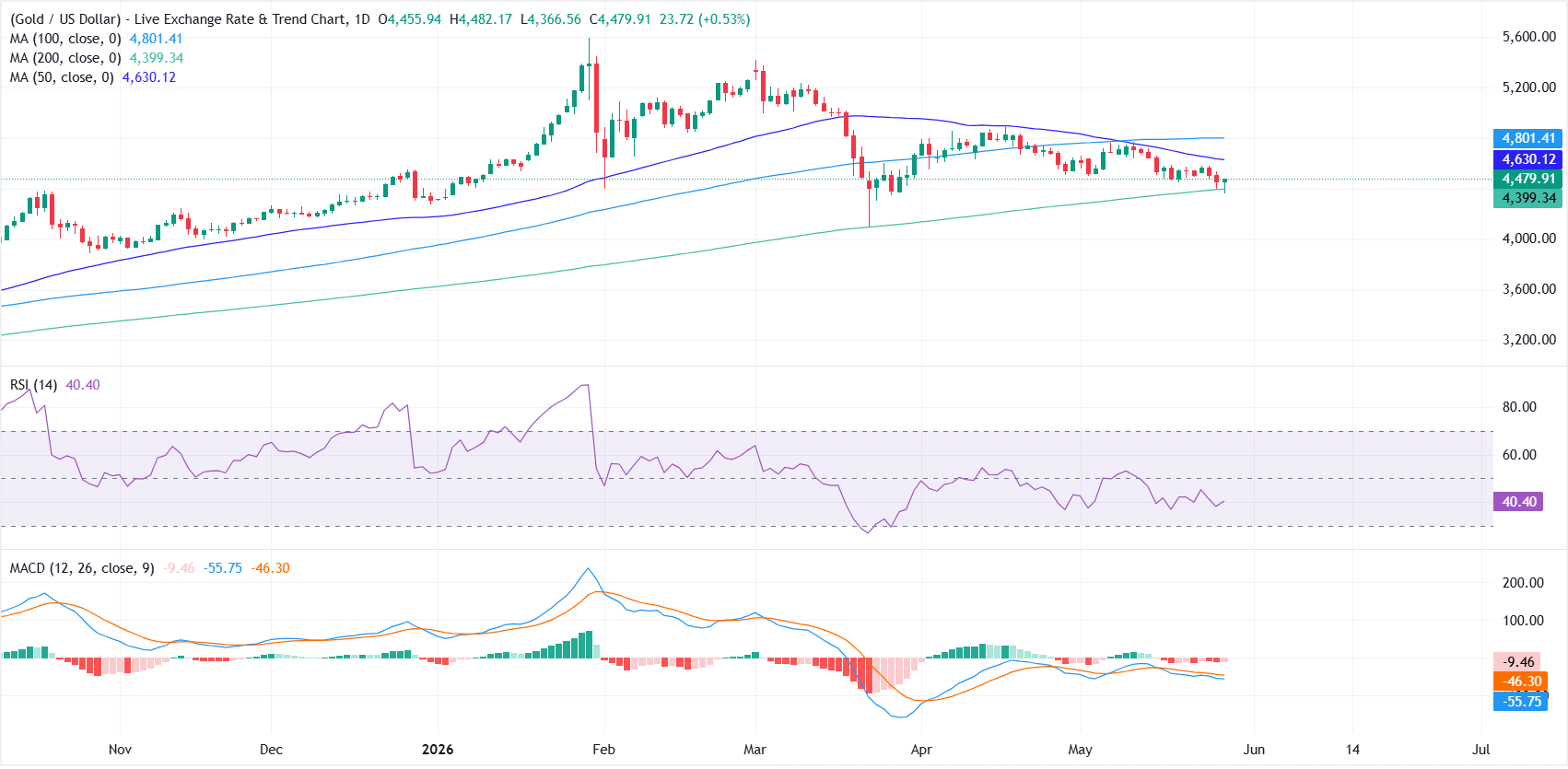
XAU/USD bounces off the 200-day Simple Moving Average (SMA) at $4,399 while remaining below the 50-day and 100-day SMAs, keeping the broader bearish outlook intact.
The Relative Strength Index (RSI) hovers near 40 and the Moving Average Convergence Divergence (MACD) remains in negative territory, which together suggest limited upside momentum and leave rallies vulnerable while the metal trades under the higher moving average.
On the topside, initial resistance is seen at the 50-day SMA around $4,630 ahead of the 100-day SMA near $4,801 and only a sustained break above this barrier would ease the current bearish pressure.
On the downside, the 200-day SMA near $4,399 acts as the first meaningful support zone, where a break would expose deeper losses and reinforce the broader corrective phase.
(The technical analysis of this story was written with the help of an AI tool.)
Gold FAQs
Gold has played a key role in human’s history as it has been widely used as a store of value and medium of exchange. Currently, apart from its shine and usage for jewelry, the precious metal is widely seen as a safe-haven asset, meaning that it is considered a good investment during turbulent times. Gold is also widely seen as a hedge against inflation and against depreciating currencies as it doesn’t rely on any specific issuer or government.
Central banks are the biggest Gold holders. In their aim to support their currencies in turbulent times, central banks tend to diversify their reserves and buy Gold to improve the perceived strength of the economy and the currency. High Gold reserves can be a source of trust for a country’s solvency. Central banks added 1,136 tonnes of Gold worth around $70 billion to their reserves in 2022, according to data from the World Gold Council. This is the highest yearly purchase since records began. Central banks from emerging economies such as China, India and Turkey are quickly increasing their Gold reserves.
Gold has an inverse correlation with the US Dollar and US Treasuries, which are both major reserve and safe-haven assets. When the Dollar depreciates, Gold tends to rise, enabling investors and central banks to diversify their assets in turbulent times. Gold is also inversely correlated with risk assets. A rally in the stock market tends to weaken Gold price, while sell-offs in riskier markets tend to favor the precious metal.
The price can move due to a wide range of factors. Geopolitical instability or fears of a deep recession can quickly make Gold price escalate due to its safe-haven status. As a yield-less asset, Gold tends to rise with lower interest rates, while higher cost of money usually weighs down on the yellow metal. Still, most moves depend on how the US Dollar (USD) behaves as the asset is priced in dollars (XAU/USD). A strong Dollar tends to keep the price of Gold controlled, whereas a weaker Dollar is likely to push Gold prices up.
