


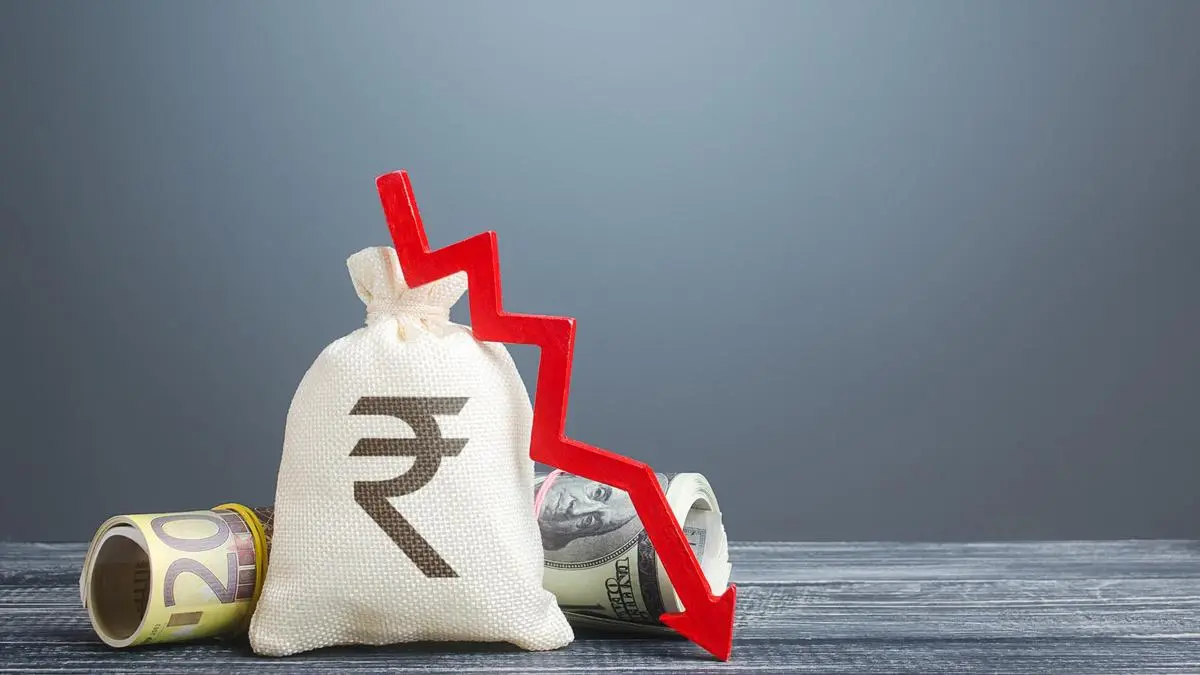
Indian rupee money bag and red arrow down. Economic difficulties. Capital flight, high risks. Costs expenses. Crisis, loss savings. Stagnation, recession, declining business activity, falling wealth.
| Photo Credit:
Andrii Yalanskyi
The rupee on Thursday pierced the 94 to the US dollar (USD) level, closing at a one-week low, amid demand for dollars from importers and the greenback gaining strength.
The Indian currency closed 35 paise weaker at 94.04 per USD against the previous close of 93.69. Itbreached the 94 per dollar for first time in March 2026.
Dilip Parmar, Senior Research Analyst, HDFC Securities, noted that the rupee surrendered its early gains amid bargain dollar buying and broad-based dollar strength.
“Aggressive dollar demand from a state-owned bank ahead of the inflation data release pushed the USD/INR pair above 94.00 after touching an intraday low of 93.62. Going forward, spot USD/INR support is seen at 93.50, while resistance is likely around 94.30,” he said.
Pranjal Ghate, Economist, Brickwork Ratings, observed that while the rupee slipped against the US dollar in early trade today, weighed down by a stronger dollar and rising US Treasury yields, these near-term fluctuations are unlikely to overshadow the broader recovery in the currency over recent weeks, bringing it back to levels last seen in April 2026.
AI hedge
“India is increasingly being viewed as a potential ‘AI hedge’ by global investors, with any further unwinding of crowded US and global AI-related trades potentially supporting foreign equity inflows into Indian markets. Alongside easing crude oil prices, these developments could provide further support to the rupee, with scope for consolidation in the 92.00–93.00 range in the coming weeks,” he said.
However, the extent of appreciation may be moderated by RBI intervention aimed at rebuilding foreign exchange reserves, while renewed crude oil volatility and broader global uncertainties remain key risks to this outlook.
Referring to the considerable decline in oil prices during this month,Dipanwita Mazumdar, Economist, Bank of Baroda (BoB), said, “We expect a US$ 9-10 billion saving in India’s oil import bill if the international oil price declines by 10 per cent in the remaining fiscal. This, along with resumption in capital flows, is expected to support the rupee in the near term.”
Meanwhile, the yield of government securities rose on anticipation of a higher inflation reading for October. Yield of the benchmark 10-year G-sec, closed at 7.25 per cent against a previous close of 7.21 per cent.
BoB’S Mazumdar said the 10-year yield is likely to be sticky under the current rate hike cycle, as global yields and the monetary policy narrative are also restrictive.
Published on November 12, 2026
