


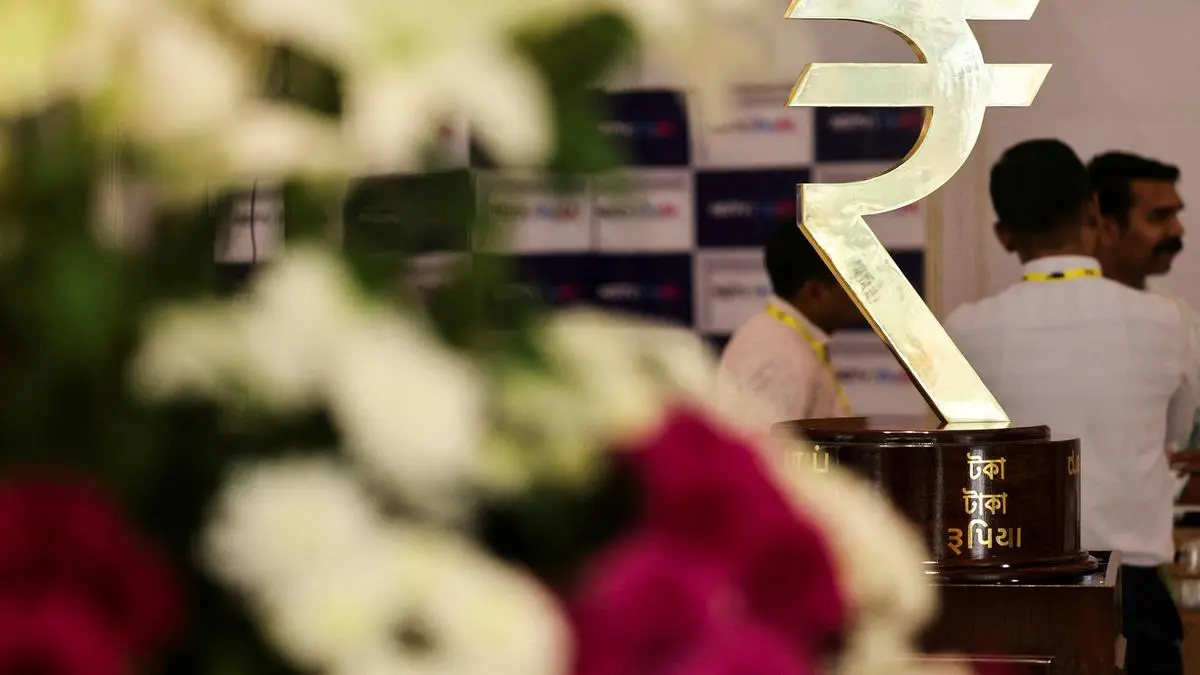
FILE PHOTO: The Indian Rupee logo is seen inside the Reserve Bank of India (RBI) headquarters in Mumbai, India, December 6, 2024
| Photo Credit:
FRANCIS MASCARENHAS
Reserve Bank of India (RBI) doesn’t view a weak exchange rate as a policy tool to gain a competitive edge in a world grappling with high tariffs, Poonam Gupta, RBI’s Deputy Governor said.
“Can exchange rate give us a competitive edge in the world of tariffs? My view is that it’s not even a policy tool,” Gupta said Wednesday at an event hosted by the Business Standard newspaper in Mumbai. “Where the exchange rate is largely determined by market forces, no country can afford to use it as a tool to gain a competitive edge.”
Gupta’s remarks, her first public comments since becoming deputy governor in April, quash speculation that authorities favored a weaker rupee to cushion the impact of the 50% tariffs imposed by US President Donald Trump. They also damp expectations among exporters seeking a preferential rate for US-bound shipments to offset the steep duties.
Currency depreciation is often seen as a way to boost exports, with China using it to counter tariff pressures during Trump’s first presidency. The rupee has been among Asia’s worst performers this year, weighed down by equity outflows and the tariff overhang, though it rebounded in October amid suspected central bank intervention to curb speculation.
The deputy governor also criticized the International Monetary Fund’s framework on exchange-rate management. “I would also like to remind the likes of the IMF that excessive volatility of the exchange rate is not necessarily a good thing,” she said. Literature shows not maintaining reserves and having a free float “do not necessarily give better outcomes than what is practiced in emerging markets,” she said.
Like many emerging economies, India follows a managed float regime and holds one of the world’s largest foreign-exchange reserves as a buffer against external shocks, Gupta said. Her comments reflect the central bank’s push back against the IMF, which reclassified India’s regime to a ‘stabilized arrangement’ from a floating system in its 2023 Article IV report, citing heavy intervention.
That classification, however, could be up for review now as Governor Sanjay Malhotra has taken a more hands-off approach to currency management, said Thomas Helbling, deputy director of the IMF’s Asia Pacific department, at a press conference in Hong Kong last week.
In her speech, Gupta said India’s near-term growth outlook remains promising, with several high-frequency indicators pointing to robust expansion in the second half of the fiscal year ending in April. The central bank expects the economy to grow 6.8% this year, which is still below the nation’s “aspirations and potential,” she said.
Speaking in the same event, India’s Chief Economic Advisor V Anantha Nageswaran said the country’s growth projections for this financial year will be ‘north’ of the 6.3%-6.8% forecast.
Gupta reiterated Governor Malhotra’s comment earlier this month that there’s room for monetary policy to ease further, though, “when and by how much is to be seen,” she said. The RBI has lowered its benchmark repurchase rate by 100 basis points since February but paused in October.
More stories like this are available on bloomberg.com
Published on October 30, 2025
