


- Gold prices rallied sharply after Powell’s dovish tone highlighted employment risks despite persistent upside risks to inflation.
- Traders priced in a 90% probability of a 25 basis-point Fed cut, with key data still ahead before September.
- Next week’s US docket includes Durable Goods, GDP, and the Fed’s preferred inflation gauge, the Core PCE Price Index.
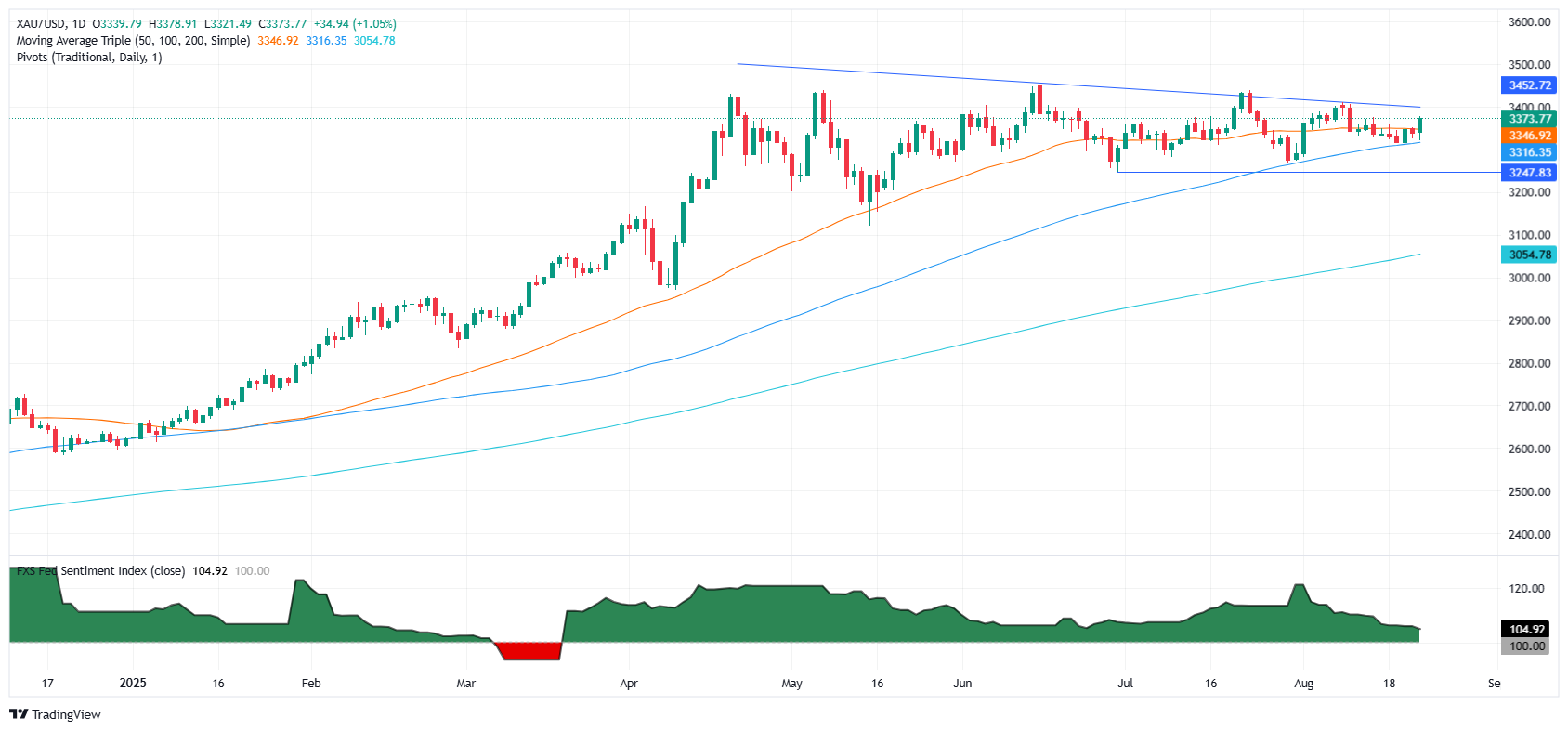
Gold prices continue to trend higher on Friday after the Federal Reserve (Fed) leaned dovish, as commented by the Fed Chair Jerome Powell, who said that “downside risks to the labor market are rising.” XAU/USD trades at $3,371 after hitting a daily low of $3,321.
The day arrived and Powell hinted that there’s a “reasonable base case” to think that tariffs would create a “one-time” increase in prices. Nevertheless, he acknowledged that risks to inflation are tilted to the upside and risks to employment to the downside, a “challenging situation.”
After his remarks, Bullion prices initially soared towards the $3,350 area before resuming to the upside, heading to a daily high of $3,378 before retreating somewhat to current price levels.
Market participants had priced in a 90% chance that the Federal Reserve will cut 25 basis points (bps) from its main reference rate, according to Prime Market Terminal. However, there are two inflation prints left and the following Nonfarm Payrolls report on September 5.
Source: Prime Market Terminal
After Powell’s speech, Cleveland Fed President Beth Hammack said that she heard that Powell is open-minded about the policy outlook, and she reiterated her stance to get inflation back to target.
Next week, the US economic docket will feature Fed speeches, Durable Goods Orders, CB Consumer Confidence, GDP figures, Initial Jobless Claims, and the Fed’s preferred inflation gauge measure, the Core Personal Consumption Expenditures (PCE) Price Index.
Daily digest market movers: Gold boosted by speculation of September rate cut
- Following Powell’s remarks, US Treasury yields tumbled, flattening the yield curve. The 10-year Treasury note is down nearly seven basis points at 4.261%. US real yields —which are calculated from the nominal yield minus inflation expectations— are down seven bps at 1.871% at the time of writing.
- The US Dollar Index (DXY), which tracks the performance of the USD against a basket of six currencies, drops more than 1% to 97.55.
- Fed Chair Powell said, “The baseline outlook and the shifting balance of risks may warrant adjusting our policy stance.” He added that “the stability of the unemployment rate and other labor market measures allows us to proceed carefully.”
- Cleveland’s Fed Beth Hammack added that the Fed is a small distance away from the neutral rate and that the “Fed needs to be cautious about any move to cut rates.” She expects a rise in inflation and in the unemployment rate.
Technical outlook: Gold price surges towards $3,400
Gold price has risen sharply, but it remains shy of testing the $3,400 mark. Bulls emerged on Powell’s remarks but remain cautious as geopolitical risk had de-escalated following upbeat news at the beginning of the week, regarding Russia and Ukraine.
If XAU/USD climbs past $3,400, the next resistance would be the June 16 high of $3,452, ahead of the record high of $3,500. On the flipside, the $3,300 figure would be the first demand zone.
Conversely, if Bullion retraces, it could halt its stop at the 50-day Simple Moving Average (SMA) at around $3,350. On further weakness, the 20-day SMA at $3,345 is up next, followed by the 100-day SMA at $3,309.
Fed FAQs
Monetary policy in the US is shaped by the Federal Reserve (Fed). The Fed has two mandates: to achieve price stability and foster full employment. Its primary tool to achieve these goals is by adjusting interest rates.
When prices are rising too quickly and inflation is above the Fed’s 2% target, it raises interest rates, increasing borrowing costs throughout the economy. This results in a stronger US Dollar (USD) as it makes the US a more attractive place for international investors to park their money.
When inflation falls below 2% or the Unemployment Rate is too high, the Fed may lower interest rates to encourage borrowing, which weighs on the Greenback.
The Federal Reserve (Fed) holds eight policy meetings a year, where the Federal Open Market Committee (FOMC) assesses economic conditions and makes monetary policy decisions.
The FOMC is attended by twelve Fed officials – the seven members of the Board of Governors, the president of the Federal Reserve Bank of New York, and four of the remaining eleven regional Reserve Bank presidents, who serve one-year terms on a rotating basis.
In extreme situations, the Federal Reserve may resort to a policy named Quantitative Easing (QE). QE is the process by which the Fed substantially increases the flow of credit in a stuck financial system.
It is a non-standard policy measure used during crises or when inflation is extremely low. It was the Fed’s weapon of choice during the Great Financial Crisis in 2008. It involves the Fed printing more Dollars and using them to buy high grade bonds from financial institutions. QE usually weakens the US Dollar.
Quantitative tightening (QT) is the reverse process of QE, whereby the Federal Reserve stops buying bonds from financial institutions and does not reinvest the principal from the bonds it holds maturing, to purchase new bonds. It is usually positive for the value of the US Dollar.
