


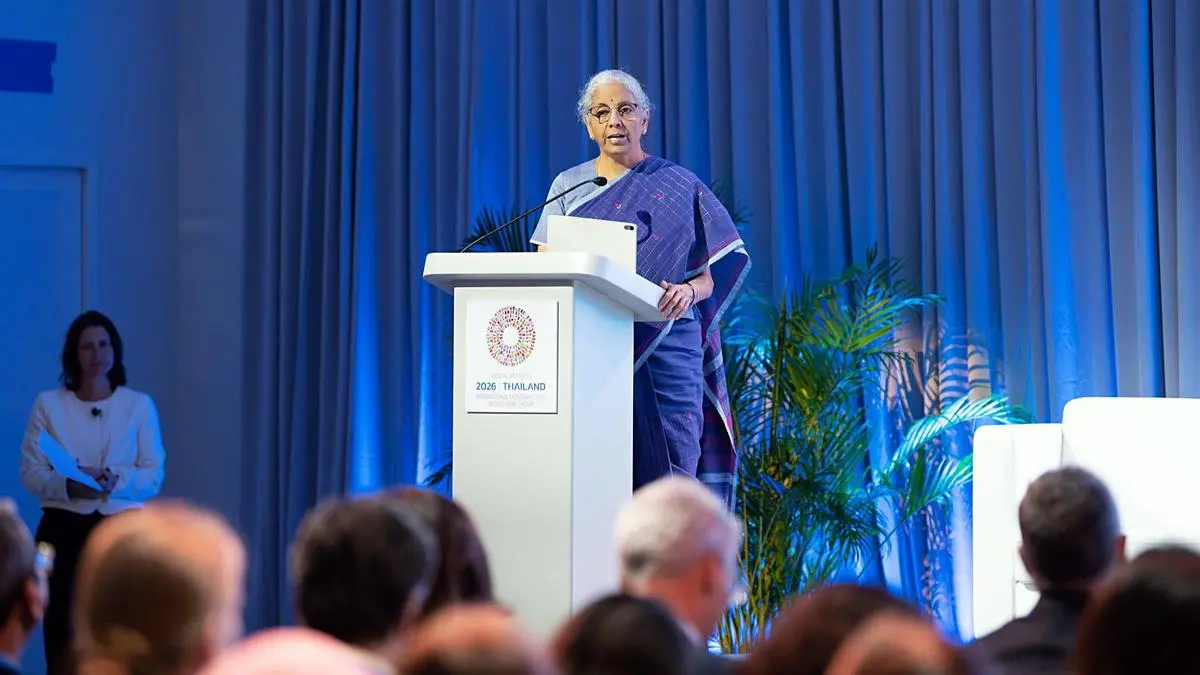
Finance Minister Nirmala Sitharaman speaks delivers the keynote address on India’s ambitious urban development programmes at the sidelines of the World Bank-IMF Annual Meetings, in Bangkok on Friday.
| Photo Credit:
ANI
India seeks to promote rupee-denominated trade settlements to assist partner nations facing hard-currency shortages and ensure uninterrupted supplies of essential goods, Union Finance Minister Nirmala Sitharaman said on Friday.
She also voiced optimism about an early resolution to trade talks with the US, while pointing out trade barriers hindering Indian exports to China.
The Finance Minister’s comments came during an interaction with the Atlantic Council on the sidelines of the IMF-World Bank annual meetings in Bangkok, Thailand.
Critical imports
Sitharaman emphasised that local currency settlements could help bridge the gap for countries facing hard-currency shortages, allowing them to sustain critical imports despite foreign exchange constraints.
“One of the things that we in India want to do is settle in rupee, whatever the payment is to be done by those countries which import goods from us,” she said.
She said India was working to facilitate settlements in rupee to ensure that trade continued with countries facing foreign currency constraints. “Rupee and local currency settlements are something which we want to do for the benefit of countries which are starved of hard currencies but yet need to import some goods, and, therefore, rupee trade is trying to make it possible for local currency settlements to keep trade going,” she said.
On the issue of India US trade, she said: “I think recently the Indian Commerce Minister has also spoken that they expect and wish to have the agreement signed soon. Negotiations have been going on. I hope, in the interest of global trade and in the interest of trade between the two partners, India and US, the trade agreement gets concluded at the earliest,” Sitharaman said. This remark has come day after when Commerce & Industry Minister Piyush Goyal said that the first phase of the India-US trade pact has been finalised and is undergoing legal drafting.
Market access
On trade with China, Sitharaman said the growing trade imbalance and persistent restrictions on market access for Indian products remained major concerns, despite years of engagement with Beijing. India has consistently sought market access in China for products such as generic medicines, bovine meat, vegetables and other perishable goods, but made little progress despite years of engagement.
“Non-tariff barriers are the biggest hurdle in the trade between India and China,” she said, adding that China had used phytosanitary measures and other non-tariff restrictions despite the potential for discussions and investigations to resolve such issues.
On India’s economic growth, Sitharaman said the country has sustained strong growth despite global disruptions and has been the world’s fastest-growing major economy over the past four to five years, particularly after COVID-19 pandemic. She attributed India’s performance to inclusive growth, wider access to resources and skill development for young people, fiscal prudence and higher public capital expenditure.
Published on October 16, 2026
