


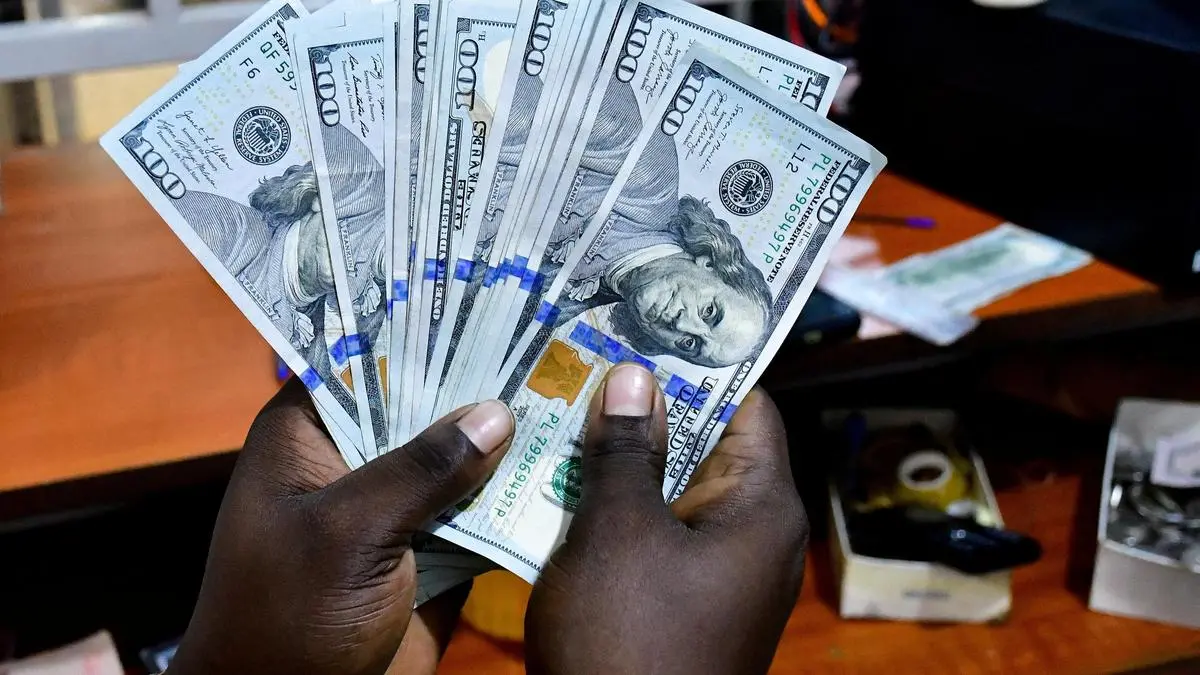
The US dollar strengthened against major currencies after stronger-than-expected September inflation data revived expectations of a Federal Reserve rate hike.
| Photo Credit:
Abubaker Lubowa
The US dollar hit
an 18-month high on Wednesday after stronger-than-expected
inflation data revived expectations for a Federal Reserve
interest rate hike later this month, highlighting concern that
price pressures are broadening across the economy.
The Labor Department’s Bureau of Labor Statistics said on
Wednesday that US consumer prices rose sharply in September as
gasoline costs surged.
“The higher-than-expected core inflation print raises
concerns that energy-driven inflation is spreading to other
areas of the economy,” said Uto Shinohara, senior investment
strategist at Mesirow Currency Management.
“October Fed rate expectations jumped…post-release,
bringing the meeting more into play.”
The US dollar index, a measure of the greenback’s
strength against a basket of six currencies, rose 0.68% to
102.86, its highest since April 2025, shaking off the previous
day’s losses.
The report overshadowed recent dovish signals from Fed
officials, including comments from New York Fed President John
Williams that weakened the dollar in the previous session.
On Thursday, Fed Vice Chair for Supervision Michelle Bowman
also signaled a wait-and-see approach before raising rates
again.
Traders now see a 56% chance that the Fed will leave rates
unchanged at its October 27-28 meeting, compared with 53% a
month ago, while pricing in about 79 basis points of tightening
by late 2027, CME Group’s FedWatch Tool showed.
“Inflation was hotter. It was more broad-based, so certainly
not a one-off type situation, which allows those that are more
dovish to ignore it,” said Marvin Loh, senior global market
strategist at State Street in Boston. “I think the Fed
ultimately is going to need to have a serious conversation
around it.”
The US central bank raised its policy rate by a quarter of a
percentage point to the 3.75%-4.00% range last month.
Fed official Thomas Barkin is scheduled to speak later in
the day. Additionally, the Fed publishes its monthly Beige Book.
EURO TROUBLES
A host of global finance chiefs are in Bangkok, where the
International Monetary Fund and World Bank are holding annual
meetings.
IMF fiscal affairs chief Rodrigo Valdes said the body has
“dialed up” the urgency of its call for governments to rein in
growing debts, while the IMF’s Kristalina Georgieva said the US
needs to make fiscal adjustments to put its debt on a more
sustainable path.
French bonds have been among the worst hit by a recent
global selloff, with investors concerned that political jostling
ahead of next year’s presidential election may hinder efforts to
reduce its high deficit.
The ECB’s Lagarde said at a CNN event in Bangkok that France
should solve its debt woes through fiscal consolidation, damping
speculation about whether the central bank might start buying
French bonds to contain yields.
The euro fell 0.69% to $1.1121, hitting a new
17-month low against the dollar and a fresh 16-month low versus
sterling as a rise in oil prices and lingering concerns about
France’s fiscal health continued to weigh on the single
currency.
Roberto Mialich, FX strategist at Unicredit, said the euro
could test $1.10 in the near term but was less bearish on the
currency into year-end, expecting that “bond yield in the US
will probably ease, although the situation in the euro zone
could weigh on the euro.”
The Financial Times reported on Wednesday that British
finance minister John Healey is expected to pay for all new
giveaways in this month’s budget with higher taxes or spending
cuts, rather than more borrowing.
The IMF is not recommending that Britain speed up its fiscal
consolidation, a senior official of the body said.
Sterling fell 0.58% to $1.3178. The Japanese
yen weakened 0.33% to 158.81 per dollar.
Published on October 14, 2026
